

Reviews are an important way to determine whether or not products, services, or establishments are worth your money. However, a growing number of fake, AI-generated reviews are making it harder and harder to know which reviews are real and which aren’t. There are a few signals that can show whether a review is generated by AI or not. Let’s take a look at a few ways to detect AI-generated reviews.
5 Ways to Detect AI-Generated Reviews

As we go through the ways to detect AI-generated reviews, it’s important to remember that AI programs change quickly; what might be a sign of AI today might not be a sign next month or next year. However, AI models are trained on text created by humans, so many of the trends remain the same over time. Generative AI attempts to mimic human writing and speech, and through this process, it sometimes overcompensates. This creates noticeable trends that can be tell-tale signs of AI-generated content.
Video reviews are harder to fake.
Try Boast to get video reviews for your business or product >
1. AI-Detection Tools
There are some ways to detect AI content yourself, but there are also tools that are designed to recognize patterns in AI content. These tools can be helpful in detecting fake reviews generated by AI. Some of these are browser extensions that can help to detect AI content while you browse the internet. This can help you see which reviews are real and which are AI-created fakes.
It’s important to note that these AI detection tools aren’t perfect, and some are better than others when it comes to detecting AI. False positives, where the tools detects AI content when it was actually written by a human, are also a known problem with these tools. Combining these tools with some other signs of AI-generated reviews can be helpful.
2. Too Many Em-Dashes or Ellipses
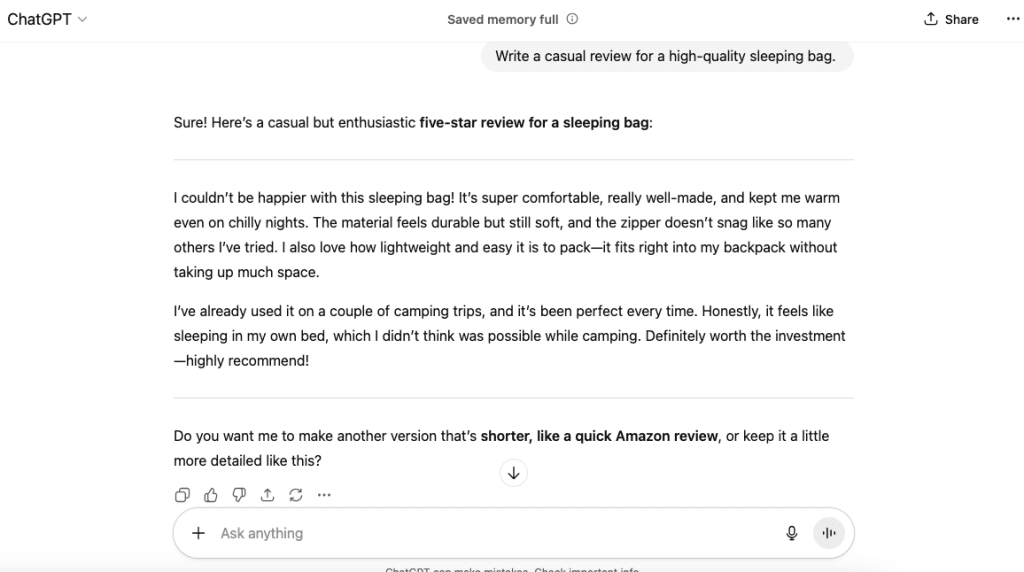
Em-dashes are longer hyphens that are sometimes used to create a pause and extra drama in a sentence—like this. Many AI tools have overused em-dashes, likely in an effort to make their content more engaging. Other fairly uncommon punctuation marks, like ellipses (that’s the three dots sometimes used to create a pause or suspense… like that), might also be overused for the same reason.
By themselves, these punctuation marks can add interest and personality to someone’s writing, so they don’t automatically indicate that the writing is generated by artificial intelligence. However, if you notice a lot of these, it can be a red flag.
3. Language is Too Casual or Too Professional

When given an instruction to make the tone professional or casual, AI programs tend to lean too far into the tone. For example, for a hotel review, an AI given instruction to sound professional might say something like “The rooms at this establishment were impeccably clean, it truly made a difference in the experience.” A person might say something like “The rooms were really clean, it was nice.”
Or, if the AI were instructed to be casual, it might say something like “Great spot, so comfy, loved it all.” A person would generally make their review a bit more complete, while still using casual language, and write something like, “Great location and nice, spacious rooms. We had a great time.”
4. Overly Dramatic
When given the instructions to review a business or product, AI programs have difficulty providing a measured response, and will tend to be either very positive or very negative. It might overuse exclamation points to create more drama and emotion, and use emotionally charged statements. For example, an AI might write a review like, “Best product ever! This changed my life! It’s so easy to use!”
By contrast, reviews that mention a few good things and some bad ones are more likely to be real. These well-rounded reviews about a whole experience are harder for an AI to mimic.
5. Generic or Inaccurate
AI reviews will lack specifics about the product, service, or business, like any fake review. Since the AI program hasn’t had any real experience with the thing being reviewed, the program can’t offer any accurate specific information about it without making it up.
You might also notice some specifics mentioned, but they don’t make sense with the other reviews. For example, a review for a hotel room might mention complimentary water bottles, but no other reviewer mentioned this. Or, it might mention features that don’t exist on a product. When assessing reviews, it can be helpful to look for consensus among the reviews. If several people mention a specific feature or issue, it’s more likely to be real.
Detecting AI Reviews
As AI becomes more sophisticated, it’s able to sound more real. However, there are a few signs of AI-generated content that are still detectable. Look for these signs as you read reviews, and you’ll be more likely to find real ones in the mix.
Posted in: Other