

Moving into 2026, marketers and business owners know that attention is harder to earn, trust is harder to build, and buyers are more skeptical than ever. Audiences are surrounded by polished brand messaging and AI-generated content that’s difficult to believe. That’s why customer stories matter more than ever in 2026. Let’s take a closer look at why that is, and what you can do about it.
Customers Stories Matter More Than Ever in 2026
Customer stories offer something brands cannot create on their own: credibility grounded in real experience. In 2026, these stories will not simply support marketing efforts; they will fundamentally shape how prospects evaluate, trust, and choose the brands they do business with. But is 2026 different than other years when it comes to honest advertising and customer incredulity? Let’s explore.
Buyer Skepticism Reaches a New High
Modern buyers have learned to question nearly every marketing claim they encounter. They expect brands to describe themselves as innovative, reliable, and customer-first, and they instinctively discount those statements. What buyers look for instead is evidence.
Customer stories provide context that brand messaging alone cannot deliver. They show how a product or service fits into real workflows, addresses specific challenges, and delivers meaningful outcomes. As skepticism continues to grow, buyers increasingly rely on the experiences of people like them to validate their decisions.

AI-Generated Content Raises the Bar for Authenticity
Artificial intelligence is growing fast and, in 2026, we’ll see AI playing a role in nearly every aspect of content creation, from blog posts to ad copy and beyond. While this makes content easier to produce at scale, it also makes originality and authenticity harder to prove. As a result, genuinely human stories become more valuable, not less.
Real customer stories stand out because they include nuance, emotion, and imperfection. These elements signal authenticity. In a world where synthetic content is everywhere, these signals help buyers distinguish between marketing claims and lived experience.
Customer Stories Influence the Entire Buyer Journey
Customer stories are no longer confined to the bottom of the funnel. In the Top of the Funnel awareness stage, they help prospects recognize themselves in a problem or scenario. During consideration, they reduce perceived risk by addressing unspoken concerns and objections. After a purchase, they reinforce confidence and reduce buyer’s remorse.
In 2026, successful brands will treat customer stories as ongoing assets that support every stage of the customer journey, rather than static testimonials placed on a single page.
Privacy-First Marketing Makes Trust-Based Content Essential
As privacy regulations like GDPR and CCPA tighten and third-party tracking becomes less effective, brands will have fewer ways to rely on aggressive targeting to drive growth. This shift places greater importance on content that persuades people naturally across different channels.
Testimonials, reviews and other customer stories excel in this role because they resonate broadly without requiring invasive data collection. A strong customer story connects through relevance and relatability, making it one of the most scalable tools for customer acquisition in a privacy-first marketing landscape.
Transparency Is a Buyer Expectation
Buyers increasingly expect brands to communicate honestly about what their products and services can and can’t do. They want clarity about who a solution is best for, what kind of results are realistic, and how it performs in real-world conditions.
Customer stories help meet these expectations by presenting outcomes through the lens of actual users. By letting customers speak in their own words, brands can build trust through transparency rather than overpromising.
Featured Resource: Testimonial Request Email Templates
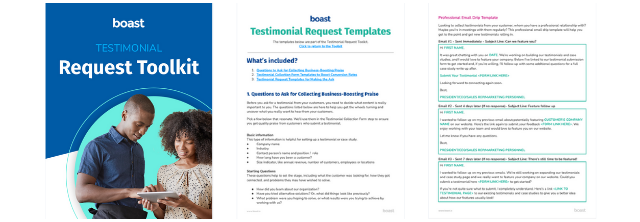
Download the Testimonial Request Toolkit
Experience Replaces Features as the Key Differentiator
In many markets, products and services now offer similar features, pricing, and integrations. As a result, differentiation is shifting away from functionality and toward experience.
When customers speak aobut their experiences, it helps to capture how it feels to work with a brand and what success looks like after adoption. In 2026, brands that consistently showcase these experiences will be better positioned to stand out in crowded markets where feature-based differentiation has diminished.
Stories Align With How People Make Decisions
Humans are wired to understand and remember stories more effectively than abstract claims or isolated data points. Stories provide structure, context, and emotional resonance, making complex decisions easier to navigate. This fundamental truth does not change with technology or trends.
In 2026, customer stories will matter more than ever not because they are novel, but because they reflect how people naturally build trust. Brands that invest in capturing and sharing real customer experiences will be the ones that earn credibility, deepen relationships, and grow sustainably in the years ahead.
Boast is the only Proof-Based Marketing platform.
Join 8,000+ organizations embracing Proof-Based Marketing to build trust, improve customer relationships, and increase sales. Start collecting feedback and sharing praise in minutes.

Boast is the only Proof-Based Marketing platform.
Join 8,000+ organizations embracing Proof-Based Marketing to build trust, improve customer relationships, and increase sales. Start collecting feedback and sharing praise in minutes.
Boast is the only Proof-Based Marketing platform.
Join 8,000+ organizations embracing Proof-Based Marketing to build trust, improve customer relationships, and increase sales. Start collecting feedback and sharing praise in minutes.
Boast is the only Proof-Based Marketing platform.
Join 8,000+ organizations embracing Proof-Based Marketing to build trust, improve customer relationships, and increase sales. Start collecting feedback and sharing praise in minutes.
Boast is the only Proof-Based Marketing platform.
Join 8,000+ organizations embracing Proof-Based Marketing to build trust, improve customer relationships, and increase sales. Start collecting feedback and sharing praise in minutes.
Boast is the only Proof-Based Marketing platform.
Join 8,000+ organizations embracing Proof-Based Marketing to build trust, improve customer relationships, and increase sales. Start collecting feedback and sharing praise in minutes.
Boast is the only Proof-Based Marketing platform.
Join 8,000+ organizations embracing Proof-Based Marketing to build trust, improve customer relationships, and increase sales. Start collecting feedback and sharing praise in minutes.
Boast is the only Proof-Based Marketing platform.
Join 8,000+ organizations embracing Proof-Based Marketing to build trust, improve customer relationships, and increase sales. Start collecting feedback and sharing praise in minutes.
Boast is the only Proof-Based Marketing platform.
Join 8,000+ organizations embracing Proof-Based Marketing to build trust, improve customer relationships, and increase sales. Start collecting feedback and sharing praise in minutes.
Widget not in any sidebars
Posted in: Social Proof